




Retatrutide: The Triple-Agonist Revolution in Metabolic Intelligence
What We Will Explore:
The Triple-Action Advantage: GLP-1, GIP, and Glucagon
The Veloura Protocol: Precision Dosing
The Escalation Roadmap (Clinical Trial Protocols: Titration)
Why Reta is Different: Weight Loss vs. Weight Quality
The Advanced Synergies: The Veloura "Elite" Stack
The Retatrutide (10mg) Reconstitution & Protocol Guide
Understanding the "2ml Reconstitution" Math
Entering the Future of Wellness
If Semaglutide opened the door to metabolic health, Retatrutide has completely redesigned the room. Often hailed as the most potent breakthrough in the history of peptide research, Retatrutide (or "Reta") is the first "Triple Agonist"—a sophisticated molecule that speaks the language of three different metabolic hormones simultaneously.
For the woman who demands the highest tier of biological precision, Retatrutide offers more than just a refined silhouette; it offers a total recalibration of how your body utilizes energy.
The Triple-Action Advantage: GLP-1, GIP, and Glucagon
Most metabolic peptides target one or two pathways. Retatrutide targets three, creating a synergistic effect that is unprecedented in clinical research:
GLP-1 (Glucagon-Like Peptide-1): The foundation of satiety. It quiets "food noise" and slows digestion so you feel satisfied with less.
GIP (Glucose-Dependent Insulinotropic Polypeptide): The metabolic stabilizer. It improves insulin sensitivity and helps the body process energy more efficiently while reducing the likelihood of gastrointestinal discomfort.
Glucagon: The energy architect. Unlike its predecessors, Reta activates glucagon receptors, which may increase energy expenditure (thermogenesis) and directly support the breakdown of stored fats.
The Veloura Protocol: Precision Dosing
Because Retatrutide is exceptionally potent, the Veloura approach prioritizes Metabolic Adaptation. We believe in "slow-burn" results—allowing the body to harmonize with the peptide to ensure comfort and long-term success.
The Escalation Roadmap (Clinical Trial Protocols: Titration)
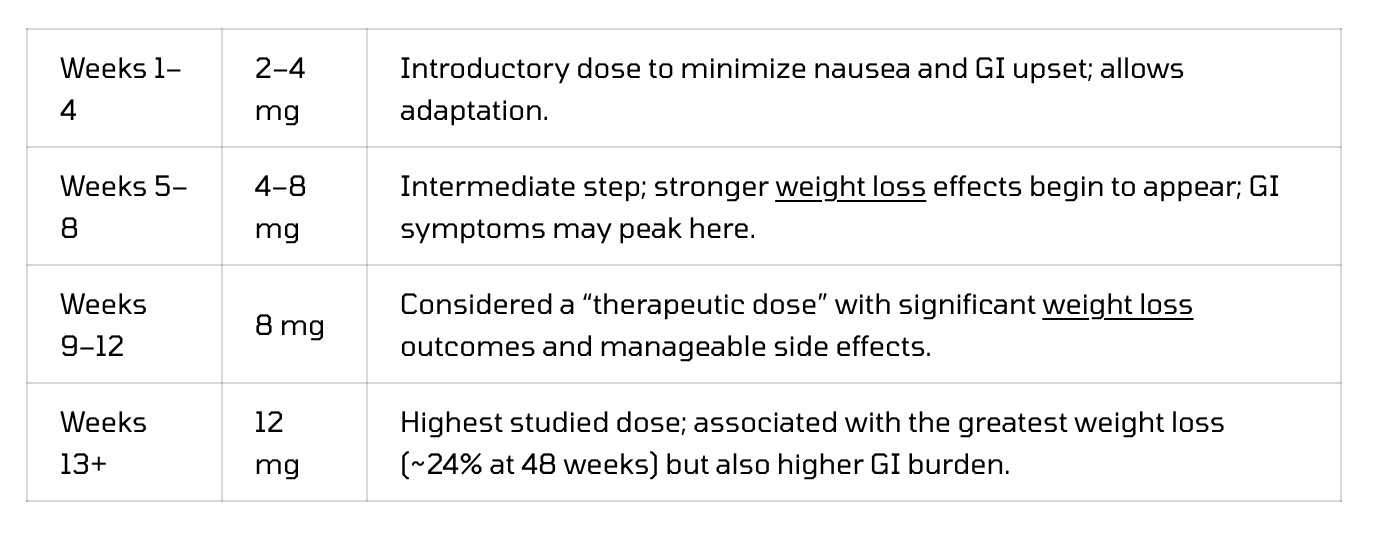
Clinical research has shown that a stepwise approach is the gold standard for maintaining vitality while the body adapts to triple-receptor stimulation.
Phase 1: The Introduction (Weeks 1-4): Starting at a conservative introductory dose (typically 2mg per week). This phase is about "waking up" the metabolic receptors without overwhelming the system.
Phase 2: The Calibration (Weeks 5-8): As the body adapts, the protocol may shift toward 4mg. This is where most researchers begin to observe a profound shift in energy and silhouette.
Phase 3: The Maintenance Tier: Higher doses (up to 8mg or 12mg) are reserved for advanced research goals, always guided by how the body responds to the initial phases.
📌 Key Points:
→ Retatrutide is given as a once-weekly subcutaneous injection.
→ Stepwise escalation is critical to reduce gastrointestinal intolerance.
→ Most participants in trials reached 8–12 mg weekly, which delivered the strongest results
→ Dosing protocols may be refined in Phase 3 and post-approval, but gradual titration will remain the standard.
Comparison to Other GLP-1s
Retatrutide’s dosing strategy stands out when compared to currently available incretin-based therapies such as semaglutide and tirzepatide. While all three are given as once-weekly subcutaneous injections, the studied dose ranges differ considerably, reflecting differences in potency, receptor activity, and tolerability.
Retatrutide vs. Semaglutide
Semaglutide (marketed as Wegovy and Ozempic) is a GLP-1receptor agonist that follows a titration from 0.25 mg weekly up to 2.4 mg weekly for obesity treatment. By contrast, Retatrutide has been studied in doses up to 12 mg weekly. Despite this higher nominal number, Retatrutide’s multi-receptor activity means that its efficacy is not just a matter of dose size, but of combined GLP-1, GIP, and glucagon stimulation.
Retatrutide vs. Tirzepatide
Tirzepatide (Mounjaro, Zepbound), a dual GLP-1/GIP agonist, uses a titration protocol beginning at 2.5 mg weekly and escalating to 15 mg weekly. Like Retatrutide, higher doses provide superior weight reduction, with clinical studies showing up to ~21% weight loss at the highest dose. Retatrutide’s advantage lies in its triple agonism, which appears to produce greater efficacy at lower relative exposure compared to tirzepatide’s maximum dosing.
🔗 Read the full article here Retatrutide vs. Tirzepatide: What's the Difference?
Why the Comparison Matters
These differences suggest that dose numbers aren’t interchangeable across drugs. While Retatrutide’s 12 mg might seem “larger” than semaglutide’s 2.4 mg, it reflects a unique pharmacologic profile rather than sheer potency. What matters most is:
→ The receptor pathways activated (single, dual, or triple agonism)
→ The degree of weight loss achieved at clinical endpoints
→ The tolerability profile at each dose escalation
By these measures, Retatrutide’s dosing strategy has set a new benchmark for weight-loss drugs currently under development.
Why Reta is Different: Weight Loss vs. Weight Quality
In early trials, participants using Retatrutide saw weight reductions exceeding 24% over 48 weeks—results that have left the scientific community in awe. But for the Veloura researcher, the focus is on quality. By activating the glucagon pathway, Reta doesn't just suppress appetite; it signals the body to burn energy more actively. This makes it an elite choice for those who want to maintain an active, high-energy lifestyle while refining their body composition.
🔗 Read More: Why I Chose Retatrutide Instead of Tirzepatide
The Advanced Synergies: The Veloura "Elite" Stack
To optimize the Retatrutide experience, we suggest pairing it with peptides that protect your foundation:
TB-500 & BPC-157 (The Recovery Duo): While Reta handles the metabolic architecture, this duo ensures your joints and tissues remain resilient during rapid body composition changes.
Mots-C (The Mitochondrial Architect): To further enhance the energy-boosting effects of the glucagon pathway, Mots-C supports mitochondrial health and exercise endurance.
The Retatrutide (10mg) Reconstitution & Protocol Guide
To help structure your research roadmap, here is exactly how to map out a standard 12-week titration protocol using 10mg vials of Retatrutide.
This plan is based on reconstituting each 10mg vial with 2ml (200 units) of Bacteriostatic Water. Administered as a single subcutaneous injection once every 7 days, here is how the math, vials, and supplies break down across the three main research phases:
The 12-Week Supply Checklist
If you are planning a 12-week schedule consisting of 4 weeks at 2 mg followed by 8 weeks at 4 mg, the quantities work out as follows:
Retatrutide (10 mg) Vials: 4 vials total
4 weeks × 2 mg = 8 mg
8 weeks × 4 mg = 32 mg
Total required: 40 mgBacteriostatic Water: 8 mL total
Based on reconstituting each 10 mg vial with 2 mL of BAC water.U-100 Insulin Syringes: 12 syringes
One new sterile syringe for each weekly administration.Alcohol Prep Pads: At least 24 pads
Allowing separate pads for disinfecting the vial stopper and preparing the injection site each week.
Quick Reference: With a 10 mg vial reconstituted with 2 mL BAC water, the concentration is 5 mg/mL. On a U-100 syringe, 2 mg = 40 units and 4 mg = 80 units.
Understanding the "2ml Reconstitution" Math
By dissolving 2ml of BAC water into a 10mg (10,000mcg) vial, you create a concentration of 5mg of Retatrutide per 1ml of liquid. This makes measuring your weekly titration exceptionally simple on a standard U-100 syringe:
10 units on the syringe = 0.5 mg
20 units on the syringe = 1 mg
40 units on the syringe = 2 mg
80 units on the syringe = 4 mg
Keeping the volume of liquid small (under 1ml per dose) ensures that even your higher-phase doses are incredibly comfortable and easy to administer, with virtually zero post-injection discomfort.
Research Notice: For research purposes only. Not for human consumption. Please ensure all sterile techniques are practiced throughout the reconstitution and administration phase.
Entering the Future of Wellness
Retatrutide represents the "Master Key" of metabolic health. It is for people who is not just looking for a change, but for a complete biological evolution. With Veloura, you aren't just following the trend; you are leading the research.
Wondering what your own symptoms might mean?
Take the free 3-Minute Systems Assessment and discover which physiological systems may be contributing to how you feel.